Artifact injection to boost anomaly detection in kidney single-cell omics
Hayat Lab at Uniklinik Aachen is seeking a: Bachelor / Master thesis (m/f/d)
Is the cell diseased, or is it the measurement?
In kidney single-cell and single-nucleus data some cells do not look like healthy tissue. They may be diseased, or the abnormality may come from how they were measured — doublets, ambient RNA, low-quality cells, stress during procurement or dissociation — and the two look alike. Current methods do not set out to separate them and tend to flag both as anomalous, so we cannot say how far findings built on those cells can be trusted.
Known answers, by construction
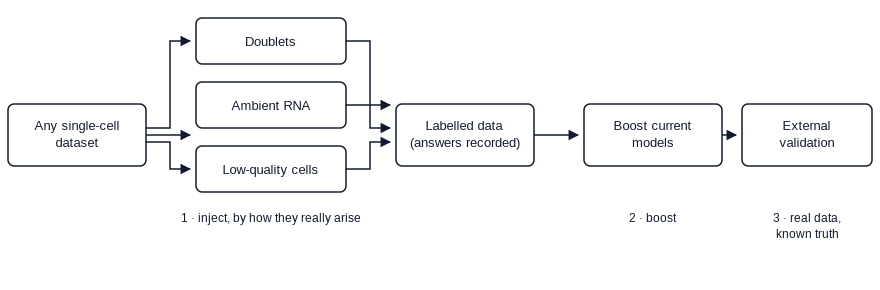
The idea is to make the answers instead of looking for them: inject artifacts into any dataset by how they really arise, recording the ground truth for every cell, and so turn it into a labelled anomaly-detection dataset. Current models are then fine-tuned on those labels to separate healthy, diseased and artifact cells, and tested only on real cells whose truth is known independently — genotype-called doublets, the same donor across assays, expert-labelled diseased cells, and healthy donors from a new lab.
Potential topics
- Build the injection pipeline for doublets, ambient RNA and low-quality cells, faithful to the mechanism by which each arises
- Fine-tune and compare current anomaly-detection models on the injected labels
- External validation on real data with independently known truth, before versus after boosting
- Model audit: are artifacts being taken for disease, and how many false alarms does a method raise
- Dataset audit: how many artifacts does a published kidney dataset actually contain
Desired Skills
Must have programming skills (Python). Experience with machine learning or deep learning (anomaly detection, out-of-distribution detection, representation learning) and/or with single-cell data analysis is advantageous. No wet lab is involved: the project works on public data, with clinical experts in the group annotating.
We Offer
A highly interdisciplinary and collaborative research environment, access to state-of-the-art single-cell and spatial omics datasets, close supervision and the chance to publish, clinical experts in nephrology and renal pathology in the group, and competitive salary and benefits according to institutional guidelines.
Apply
Please submit a CV, a brief motivation letter and relevant supporting documents to erjin@ukaachen.de