Verifiable research agents for chronic kidney disease
Hayat Lab at Uniklinik Aachen is seeking a: Bachelor / Master thesis (m/f/d)
Make an AI agent’s conclusions checkable
AI agents can already read the literature, analyse kidney single-cell data, write and run their own analysis code and propose hypotheses about chronic kidney disease. What is missing is a layer that makes those conclusions verifiable: today they arrive as free text, the process is opaque, and nobody catches errors systematically. This thesis does not build another agent — it builds the harness around it.
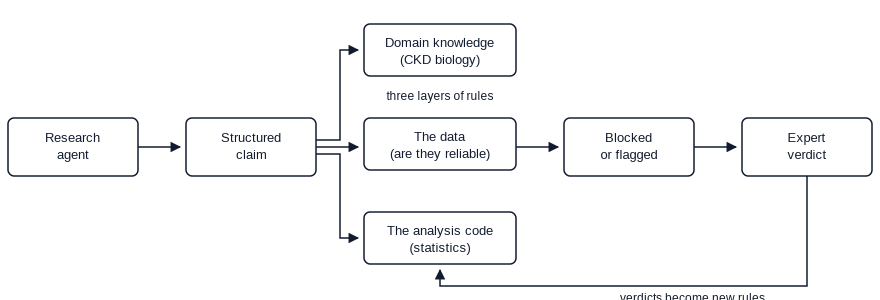
A rule engine at the core
Every conclusion is turned into a structured claim and checked on three layers: domain knowledge (does it fit CKD biology), the data (are they reliable), and the analysis code (are the statistics and computations right). A broken hard rule blocks the claim, a broken soft rule flags it. Experts then see only the claims with the largest rule conflicts or the most uncertainty, instead of reading whole reports, and their verdicts become new rules, so the rule base improves round by round.
Potential topics
- Design and implement the rule engine: structured claims, hard and soft rules, and versioning of the rule base
- Rules for the traps specific to single-cell statistics, such as treating thousands of cells from one patient as independent samples
- Active selection of the claims that are worth an expert’s time, and turning expert verdicts back into rules
- Wrap the harness around different agents and measure how much the harness, rather than the model, explains performance
- Evaluation by planting known errors and counting what is caught, and by testing whether checked conclusions hold more often in independent CKD patient cohorts
Desired Skills
Must have programming skills (Python). Experience with large language models, agent frameworks or tool use, and/or with single-cell omics, applied statistics or biomedical data analysis is advantageous. No medical background is required; clinical experts in the group annotate.
We Offer
A highly interdisciplinary and collaborative research environment, access to state-of-the-art single-cell and spatial omics datasets, close supervision and the chance to publish, clinical experts in nephrology and renal pathology in the group, and competitive salary and benefits according to institutional guidelines.
Apply
Please submit a CV, a brief motivation letter and relevant supporting documents to erjin@ukaachen.de