Knowledge graphs in the biomedical domain: knowing the unknown knowns to discover new therapies from data
Integrating biomedical databases and single-cell data into knowledge graphs, and using graph representation learning to find therapeutic targets.
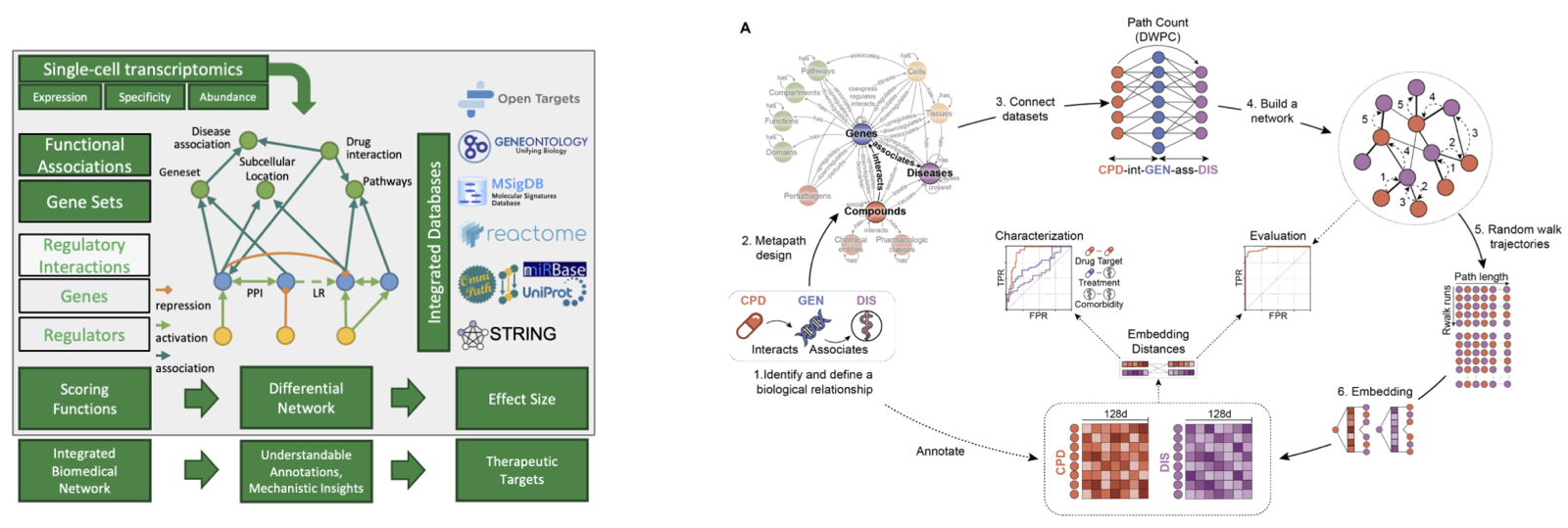
Background
Current state of knowledge graphs in precision medicine, scalable graph representation learning for biomedical data, future directions combining omics with knowledge graphs.
Questions we are working on
- How can diverse biomedical datasets be mapped to ontologies, standardized and integrated into a common space?
- What are node and edge embeddings?
- How should shallow and deep networks be built?
- How can network inference be made efficient enough for target discovery?
Key literature
- Chandak P, Huang K, Zitnik M. Building a knowledge graph to enable precision medicine. Sci Data (2023). [PrimeKG]
- Richardson P, et al. Baricitinib as potential treatment for 2019-nCoV acute respiratory disease. Lancet (2020).
- Li MM, Huang K, Zitnik M. Graph representation learning in biomedicine and healthcare. Nat Biomed Eng (2022).
- Joppich M, Kramann R, Hayat S. PICASO: Profiling Integrative Communities of Aggregated Single-cell Omics data. bioRxiv (2024). [Hayat Lab]