Gene circuits: building gene-regulatory networks from single-cell data
Inferring cell-type-specific gene-regulatory networks from single-cell data and perturbing them in silico.
Background
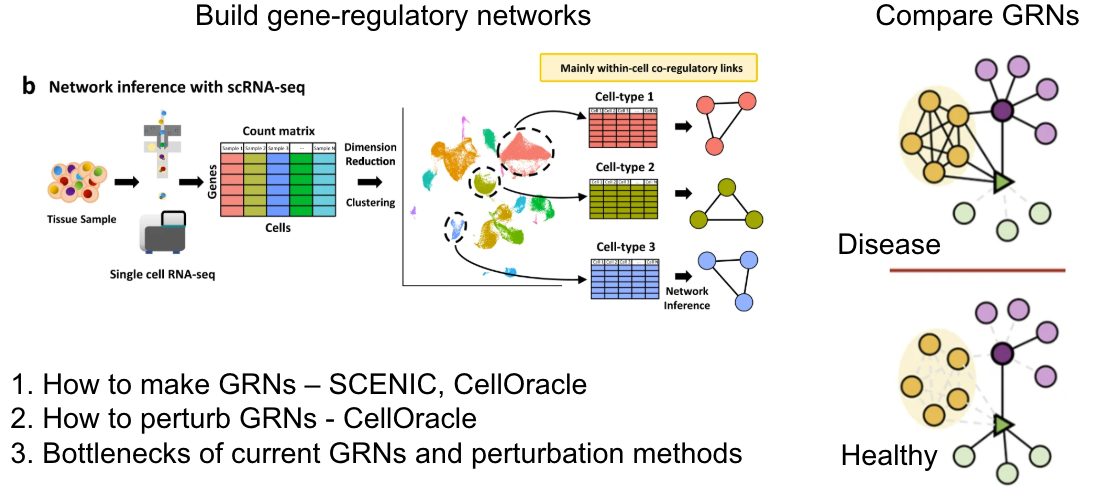
Biological systems are complex: genes act through their interactions with one another, and these interactions can be represented as gene-regulatory networks (GRNs). Single-cell data make it possible to build such a network for each cell type.
Two questions follow: how such networks can be created from sparse data, and how perturbation biology approaches and in silico gene knock-outs (node elimination) can then be used to understand human health. Methods such as SCENIC and CellOracle address these steps.
Questions we are working on
- How do existing approaches, for example SCENIC and CellOracle, construct GRNs from single-cell data, and how should the resulting networks be compared?
- How can GRNs be perturbed, for example with CellOracle?
- What are the bottlenecks of current GRN inference and perturbation methods?
- Which similar methods can be built on flow matching?
Key literature
- Cha J, Lee I. Single-cell network biology for resolving cellular heterogeneity in human diseases. Exp Mol Med (2020).
- Kamimoto K, et al. Dissecting cell identity via network inference and in silico gene perturbation. Nature (2023). [CellOracle]
- Aibar S, et al. SCENIC: single-cell regulatory network inference and clustering. Nat Methods (2017).