From cell segmentation to spatial pattern discovery
Methods for the full spatial transcriptomics workflow: segmenting cells, quantifying their spatial relationships and finding recurring tissue niches.
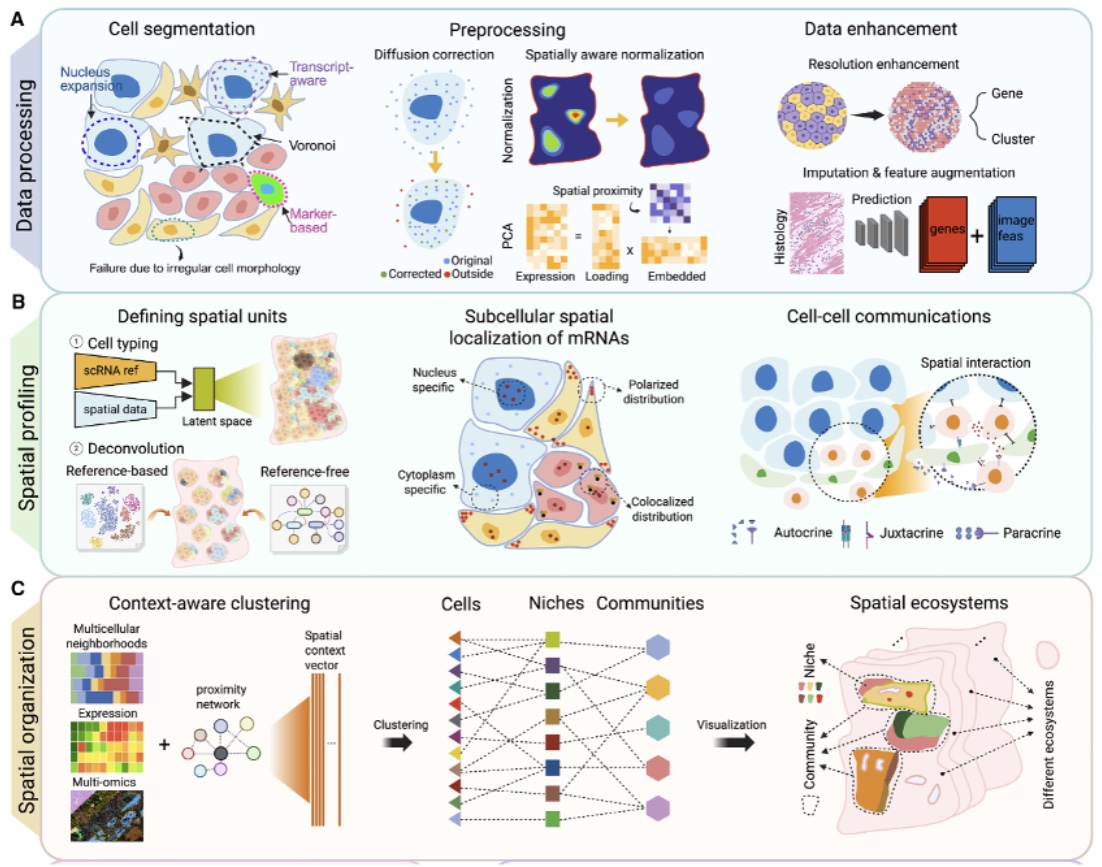
Background
Spatial transcriptomics measures gene expression while preserving the architecture of the tissue. That advantage comes with computational challenges at every step of the analysis: cells have to be segmented, the spatial relationships between cells have to be quantified, and tissue-level patterns such as niches have to be found among them.
Questions we are working on
- What are the methods for cell segmentation in spatial transcriptomics, and is segmentation-free analysis possible?
- How can spatial relationships between cells be quantified, for example through co-localization, diffusion or alignment?
- How can recurring spatial patterns, such as niches and spatial domains, be discovered from spatial data?
Key literature
- Williams CG, et al. An introduction to spatial transcriptomics for biomedical research. Genome Med (2022).
- Yao Z, et al. A high-resolution transcriptomic and spatial atlas of cell types in the whole mouse brain. bioRxiv (2023).
- Greenwald NF, et al. Whole-cell segmentation of tissue images with human-level performance using large-scale data annotation and deep learning. Nat Biotechnol (2022).
- Petukhov V, et al. Cell segmentation in imaging-based spatial transcriptomics. Nat Biotechnol (2022).
- Park J, et al. Cell segmentation-free inference of cell types from in situ transcriptomics data. Nat Commun (2021).
- Hu Y, et al. Unsupervised and supervised discovery of tissue cellular neighborhoods from cell phenotypes. Nat Methods (2024).
- Benjamin K, et al. Multiscale topology classifies cells in subcellular spatial transcriptomics. Nature (2024).
- Liu Y, Dai Y, Wang L. Spatial omics at the forefront: emerging technologies, analytical innovations, and clinical applications. Cancer Cell (2026).
- Ceccarelli F, et al. Topography Aware Optimal Transport for Alignment of Spatial Omics Data. bioRxiv (2025).